
You’ve opened every window, lit enough candles to stock a boutique spa, and maybe even waved a reed diffuser around like you’re conducting an orchestra.
The room should smell like a retreat by now, or at least like something other than stale cigarettes or yesterday’s pizza that got a little too smoky.
Except it doesn’t. The smell is still there, clinging to your carpet like an unwanted house guest who’s grown far too comfortable. Luckily, you can get rid of it without fancy equipment or a chemistry degree. Let’s sort it out.
Clear the Surface First
The first thing you need to do is get rid of anything visible sitting on the surface.
If there’s ash and tiny bits of debris sitting on top, they’re part of the problem. And they’ll get smeared deeper into the pile the moment you introduce moisture or start treating your carpet.
Start by giving your carpet a thorough pass with your vacuum. The rushed dash you do when someone texts to say they’re arriving early will do you no favours here.
Instead, go over the affected area multiple times, moving in different directions to lift as much residue as possible.
If the smell is concentrated in one particular spot, give that area extra passes. You want to pull out everything that isn’t embedded in the fibres yet.
Let Fresh Air Do the Heavy Lifting
It’s tempting to dive straight into treating your carpet, but if the room itself is still holding onto smoke, you’ll be working against yourself.
Throw the windows open, and if you can create a proper cross-breeze, that’s even better. Let fresh air move through the space and carry away lingering odours that are clinging to walls, curtains, and upholstery.
If you’re using fans, place one near an open window and angle it to blow air outside. That way, they’ll push the stale air out instead of just swirling it around the room.
If the smell is particularly stubborn, you might need to air the room for several hours or even repeat the process over a couple of days.
Fresh air won’t fix the problem entirely, but it’ll give you a head start by reducing the odour’s intensity. From there, you can target the remaining smells trapped in your rug.
Try the Baking Soda Method
Now, you’re ready for one of the simplest, most reliable tricks in the book.
Baking soda doesn’t just cover up smells; it actually absorbs them. So, instead of adding another scent on top, you’ll nip the problem in the bud.
Take a box of baking soda and sprinkle it generously over your carpet. Focus on the areas where the smell seems most concentrated, and don’t hold back. You want a visible layer covering the surface, not a half-hearted dusting.
Leave it in place for at least a few hours or overnight if possible.
Then, vacuum thoroughly. Again, take your time. You want to remove all that powder along with the odour it’s absorbed.
For mild smoke smells, this step alone can make a noticeable difference. If the scent has faded but not disappeared entirely, don’t worry. A second round can usually take care of the rest.
Prepare a Vinegar Solution
If you’ve tried baking soda but there’s still a faint smell lingering, it’s time to step things up.
Just like baking soda, vinegar neutralises the compounds responsible for smoke smells instead of simply covering them up. So, it’s an effective solution you should definitely try.
Mix equal parts white vinegar and warm water in a spray bottle. Lightly mist the affected areas, making sure not to soak your carpet. A gentle, even spray is enough.
Yes, vinegar smells sharp at first, but as it dries, that acidic scent fades, taking stubborn smoke odours with it.
Before spraying your solution over a wide area, though, test it on a small, hidden patch to make sure your carpet reacts well. Most modern fabrics handle diluted vinegar just fine, but it’s always worth checking.
Once you’ve applied it, allow your carpet to air dry completely and open the windows again if possible.
Target Stubborn Patches with an Enzyme Cleaner
Even after all that effort, you might notice one spot that just won’t cooperate.
Maybe it’s the spot near your favourite sofa or that corner that doesn’t get much airflow. Some areas simply hold onto odours more than others.
That’s where an enzyme-based cleaner can help. These products break down organic compounds at a molecular level. Instead of disguising the smell, they target what’s causing it.
Apply the cleaner to the affected area and allow it enough time to work properly before blotting or lightly rinsing the fabric. A little patience goes a long way here, as enzymes need contact time to be effective.
And before treating the full patch, test a small, hidden area first to avoid any surprises.
Go Deep with a Carpet Machine or Steamer
If the smell feels like it has become part of the carpet itself and surface treatments are barely making a dent, it is time to bring out the bigger tools.
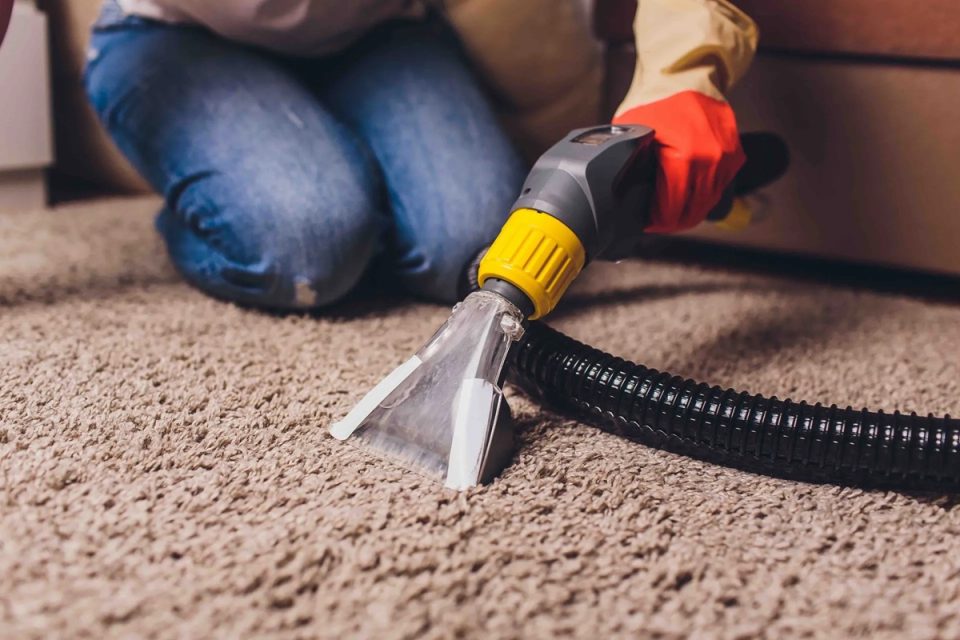
A carpet washing machine or steamer allows you to get deep into the fibres and flush out the residue that has settled in where a regular vacuum can’t reach.
For the best results, use a suitable cleaning solution, move the machine slowly, and overlap your passes to make sure you are covering everything evenly.
If you don’t own a machine, renting one for the day can be a practical option.
However, in cases of heavy smoke exposure that happen after small fires, booking a professional carpet clean with a service is usually the most effective solution.
They have industrial-grade equipment designed to tackle stubborn odours that DIY methods can’t fully remove.
Dry Everything Properly
After all that effort treating your carpet, the last thing you want is to create a new problem by leaving it damp for too long. If you don’t dry it properly, your rug can develop its own musty smell surprisingly quickly.
To prevent this, open the windows to let air circulate, set up fans to keep things moving, and if you have a dehumidifier at home, now is the time to use it.
Keep everything running until your carpet feels dry to the touch.
Also, try to avoid walking on the area while it’s still damp. Foot traffic pushes moisture deeper into the fibres and the underlay, which slows down the drying process and can cause problems later on.
This can take only a few hours or most of the day, depending on the weather and how thick your carpet is.
Sure, it’s not the most exciting part of the process, but it is absolutely essential if you want your hard work to last.
Conclusion
Now that you know what works, there’s no reason to live with that smell any longer. So, open the windows, reach for that box of baking soda, and tackle the worst areas first.
Before long, your living room won’t be broadcasting the memory of every cigarette or slightly overconfident cooking experiment. Just give it an afternoon, and you’ll walk back into a space that finally smells fresh.
